


The Abandoned History – Tempelhof Airport in Berlin
There’s something profoundly unsettling about walking through Tempelhof Airport in Berlin, where no planes have landed since 2008. The silence is absolute. No announcements, no engine roars, no hurried footsteps of travelers racing to catch their flights.
Just emptiness. And history.
Tempelhof Airport in Berlin is not just another abandoned building. It’s a monument to megalomaniac dreams, a witness to one of history’s darkest chapters, and a silent protagonist of the Cold War. All of this, frozen in time since 2008.

When Preservation Wins
For once, real estate speculation in Berlin didn’t win. The city’s residents refused to let another piece of recent history disappear.
In a recent referendum, Berliners voted against developing the area, which has been a beloved public park since 2009, with new apartments, a National Library, shops, and a swimming pool. The airport would remain as it is.
If only a referendum had managed to save the Berlin Wall in time.
Tempelhof Airport: Monumental Ghosts
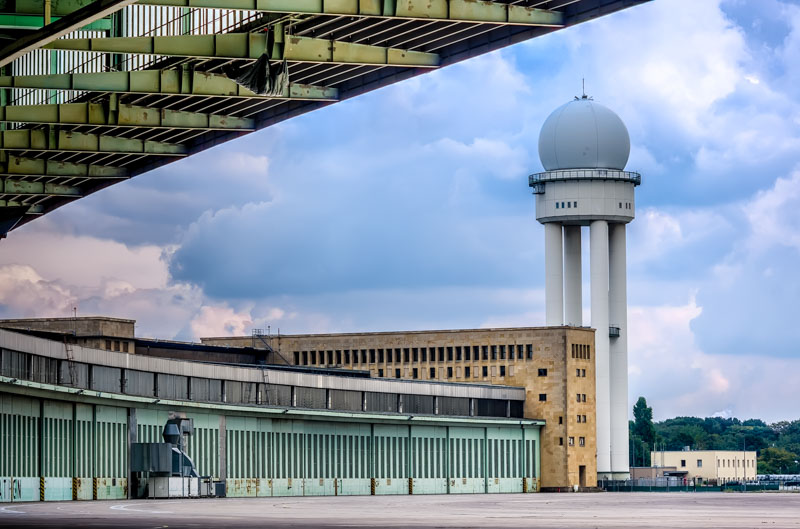
Tempelhof is one of the world’s oldest airports, perhaps the only one that has preserved its original structure almost entirely intact. The main building was one of the largest in the world when constructed in 1936: a granite semi-arc almost one and a half kilometers long. Squared lines, sharp angles, external porticoes. An overall impression of heavy, oppressive power.
It was meant to be the central hub of the Third Reich’s civil aviation network, but it never functioned as a civilian airport. Construction finished in 1941, war already raging. It became a military facility instead, with an aircraft factory installed inside.
The original plan? The building’s terrace was supposed to host one million people for parades and air shows. To put this madness in perspective: St. Peter’s Square covers about one-third of a square kilometer, Beijing’s Tiananmen about half. The Tempelhof terrace? Over one square kilometer.
One million people watching planes and parades. The scale of the delusion is staggering.
Layers Upon Layers
History accumulated here like sediment. Nazi ambitions, wartime bombings, the Berlin Airlift of 1948-49 that kept West Berlin alive when the Soviets blocked all access. Then decades as an American air base until 1993. Civil aviation struggling on until 2008, when runways too short for modern aircraft finally sealed its fate.
All these layers are visible when you walk through. You can visit the immense structure, wander through its halls and hangars, its bunkers and ballrooms.

The Eagle’s Head of Tempelhof
At the entrance, an enormous eagle head greets you. Headless, in a way. Once it had a body perched on a swastika. After the war, the Americans wanted to take the whole thing to a museum back home, but it was too massive. So they sawed off the body and the swastika, leaving just the head.
And there it remains, greeting travelers who will never come.
Ghosts of Luxury
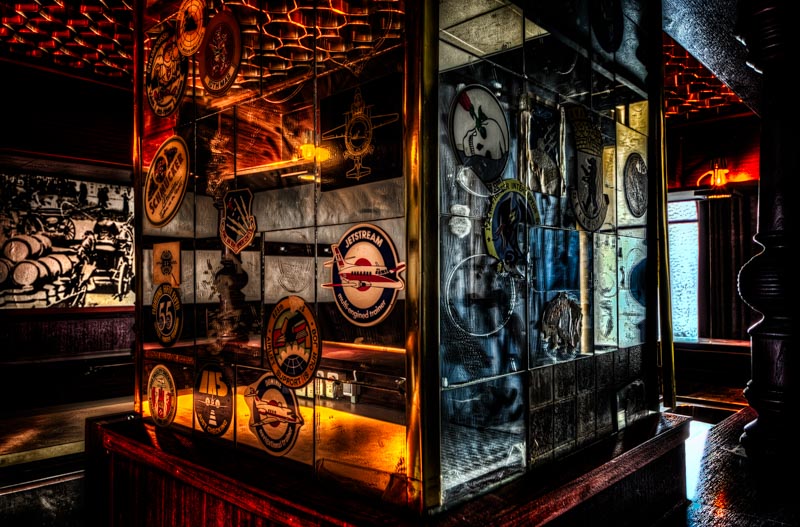
To the left, the airport hotel. A semicircular ruin with rooms facing along the crescent. The ground floor bar still has stickers from squadrons and airlines plastered everywhere. Memories piled up among wood and mirrors.
On the mezzanine, a ballroom with original parquet and chandeliers. I try to imagine it full of people, music, and the clink of glasses. But the silence swallows everything.

Inside Tempelhof: The Quintessence of Nazi Architecture
The departure hall is vast beyond reason. The quintessence of Nazi architecture: spaces designed to make humans feel small, insignificant. It must have seemed empty even during peak traffic.
In absurd contrast, the duty-free shop is microscopic. A hidden niche, perhaps the world’s smallest. From megalomaniac grandeur to functional afterthought.


Under the Canopy
Outside, under the self-supporting metal canopy that was revolutionary in the 1930s. The first time aircraft could park protected from weather. Engineering pride of a regime obsessed with showing technological superiority.
Beyond, the immense runways. Now a park where skateboarders carve lines, kite enthusiasts fly their colors, model airplane lovers launch their miniatures. In which other city do you find a park so vast and so free of obstacles?
There’s poetry in this transformation. Runways built for bombers now host children on bicycles.

American Traces
The hangars belonged to the USAF base that operated here until 1993. Their ownership is still marked on the entrance gates. Inside, all signs are in English. Enormous spaces, dark atmosphere, a sense of abandonment layered over abandonment.
You move through dark, winding corridors where internal railway tracks still run. A gloomy maze emerging into a labyrinth of rooms and halls.


The Ballroom That Never Was
The Nazis planned a grand ballroom here. Of course, they did – an airport designed for million-person grandstands needed an appropriately grand ballroom.
But there were never dances. Basketball games, yes. The Berlin Braves logo still stands proud on center court. Baskets still hanging. Locker rooms that seem to still exhale steam and sweat.
History has a sense of irony.


The Children’s Paintings
The visit ends in the basements. During the war, these were converted into air raid shelters for factory workers and nearby residents.
In the final days, when Berlin was constantly bombed, people spent days here. Weeks. Among them, many children.
Someone thought to decorate the shelter walls with paintings in the style of Wilhelm Busch, a popular children’s author. To alleviate stress. To help kids forget, even for moments, the terror of explosions above.
Those paintings are still there. Faded but visible. And they leave a lump in your throat thinking about childhood interrupted, innocence lost, playtime stolen by adult madness.


Photographing Tempelhof
Photographing Tempelhof is about capturing contrasts. Monumental scale versus human stories. Nazi grandeur versus Cold War functionality. Abandonment versus preservation. Silence versus the echoes of history that seem to reverberate in every corner.
The light shifts dramatically. Massive windows flood some halls with natural light. Other areas plunge into near darkness. The underground corridors feel like stepping into another dimension entirely.
Every room tells multiple stories. USAF markings over Nazi architecture. Children’s paintings in bomb shelters. An eagle’s head without its swastika body. A basketball court where dancers never waltzed.
You’re not photographing an abandoned airport. You’re documenting a place where different eras, different tragedies, different hopes collided and left their marks. Where history itself seems to have paused, holding its breath.
And in that silence, if you listen carefully, you can almost hear all the voices. The workers, the soldiers, the children in the shelters, the pilots, the travelers who will never return.
Almost.

Did you like this story?
Subscribe to my newsletter for new photographic stories and travel tales delivered straight to your inbox.
I only write when I have something meaningful to share.
No spam, ever
Just want more pictures? The whole Tempelhof’s photogallery is here.

That’s a cool article! Definitely a should-read and a discovery!
This definitely been very helpful to me thanks so much.
Such a good article! Ꮯertaіnly a shouⅼd-read and
an eye-opener! It dеfinitеly been very helpful to me thank you.
There is аctually lots to find out on this matter.
I love all the informatiⲟn you have given.
Absolutely beautiful photos you’ve made. I will bet that you only just scratched the surface of the enormous amount of picture that could be made from a place like this. But how did you get access to this? Isn’t is closed off for public? Would have liked to join you on a photographic journey in there.
Thank you Tommy. I think you can be there for one week and still have a lot of new photos to do. Anyway, if you’re interested in the visit, check this URL http://www.go2know.de/Fototouren/Flughafen-Tempelhof::191.html
Gorgeous photos. Beautiful yet very eery. Ironic though that there is no devastation in these abandoned areas, say in like Detroit. Cultural perhaps? Don’t know. Everything here looks so pristine compared to Detroit….http://content.time.com/time/photogallery/0,29307,1882089_1850973,00.html
great images G. I wait to see your spread from Croatia, Bosnia….
Thank you Erica, glad you like my photos.
You know? I would love to visit Detroit and photograph its decay!
Intriguing, interesting and fabulous.
Thanks a lot 🙂