Home»Travels»Spain» In the footsteps of Quixote: tilting at windmills!
Do you remember the foolish stories of Don Quixote?
Do you remember when he was battling against windmills?
This is one of the chapters of Cervantes’s book that I like the most and have read repeatedly.
At this point they came in sight of thirty forty windmills that there are on plain, and as soon as don Quixote saw them he said to his squire: “Fortune is arranging matters for us better than we could have shaped our desires ourselves, for look there, friend Sancho Panza, where thirty or more monstrous giants present themselves, all of whom I mean to engage in battle and slay” “What giants?” said Sancho Panza “Those thou seest there”, answered his master, “with the long arms, and some have them nearly two leagues long”
La Mancha, Spain
Inspired by this chapter, at a certain point in my life, I decided to go visit the Spanish land of windmills, to feel a bit like Don Quixote. And to see the beautiful Mancha region of Spain, of course!
However, where exactly are those windmills?
No one really knows it. Mr Cervantes was very vague in the definition of all the locations of his novel, even of Don Quixote’s birthplace.
For centuries, academics have argued over the exact location of all the geographical spots cited in the book.
And it’s not only a theoretical debate. Tourists bring money. Every “pueblo” in La Mancha dreams of more visitors and tries to attract them. Statues of Don Quixote, Dulcinea del Toboso and Sancho Panza are in almost every village. But, on the topic of windmills, the debate seems to be confined to two villages: Consuegra and Campo de Criptana.
Now, I don’t really know whether Mr Cervantes was thinking of one of these locations when he wrote the chapter of the book or of other unknown locations.
Where are the windmills?
For example, this white lonely windmill in Mota del Cuervo is a perfect location for a cowboy movie and could also be a good source of inspiration for Cervantes.
Regardless of the debate, what I know is that both these pueblos, Consuegra and Campo de Criptana, are fascinating destinations.
Generally speaking, the whole Mancha is a beautiful place for a weekend trip from Madrid or for a detour while en route for Andalucia. You’ll feel out of time and space after a short drive out of the Spanish capital.
The arid inner plateau has harsh colours on which the whitewashed houses of the pueblos shine almost unsustainably under the sun. But it’s not only a matter of desert fascination and old-time villages. Moreover, you’ll find real gems here.
Almagro
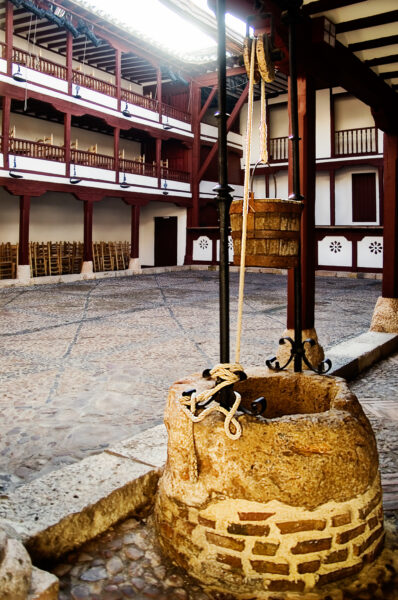
Let’s start with the Plaza Mayor of Almagro. Here you can think you have been rocketed in time and space to medieval Belgium or Holland. Still in Almagro, you can visit the Corral de Comedias. It’s an open-air courtyard theatre built in 1628.
And if you’re lucky enough, you can also attend a performance in the only functioning courtyard theatre still standing.
Cuenca
Alternatively, the beautiful Cuenca and its Casas Colgadas (Hanging Houses) have stood high above a river creek since the 15th century.
Consuegra
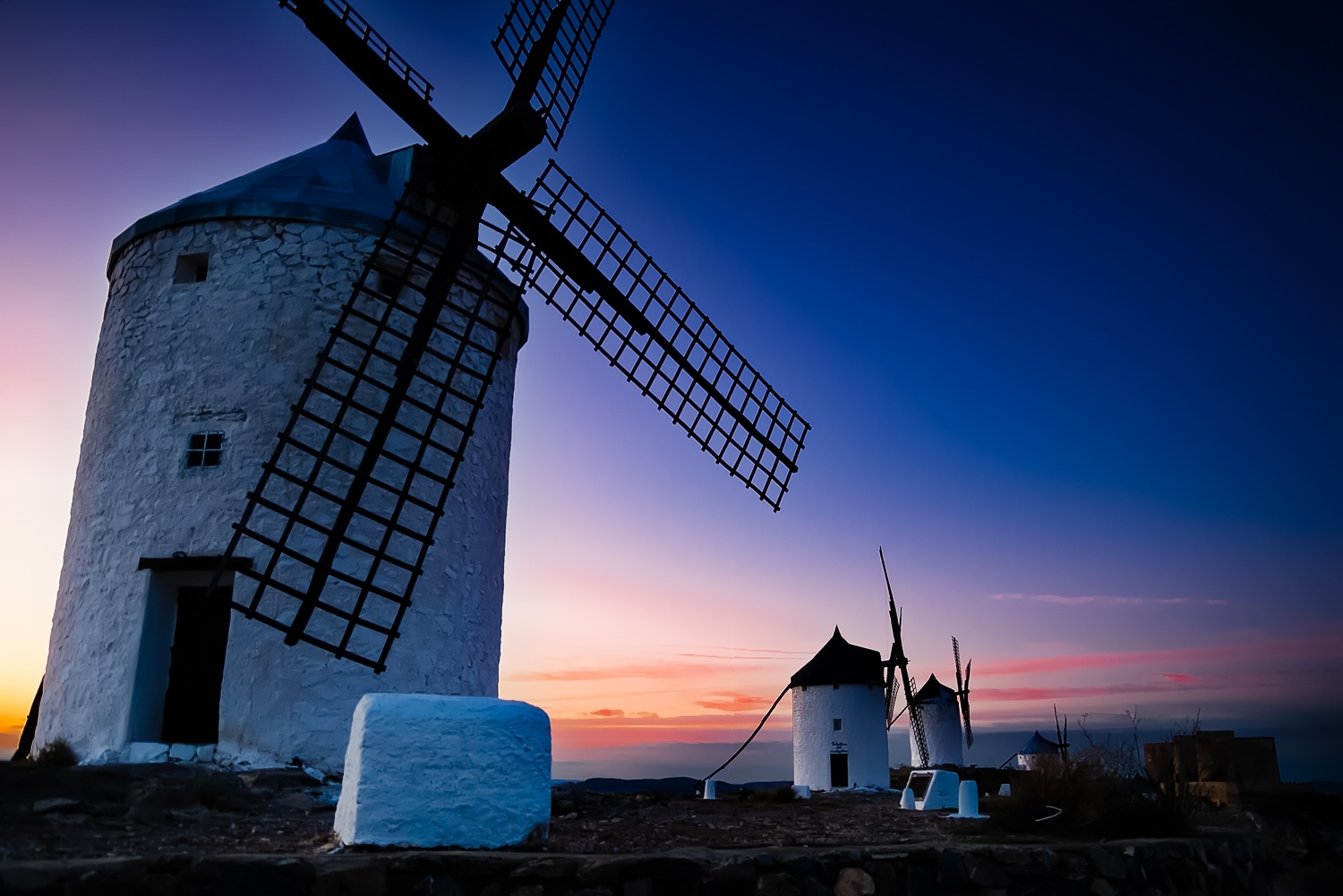
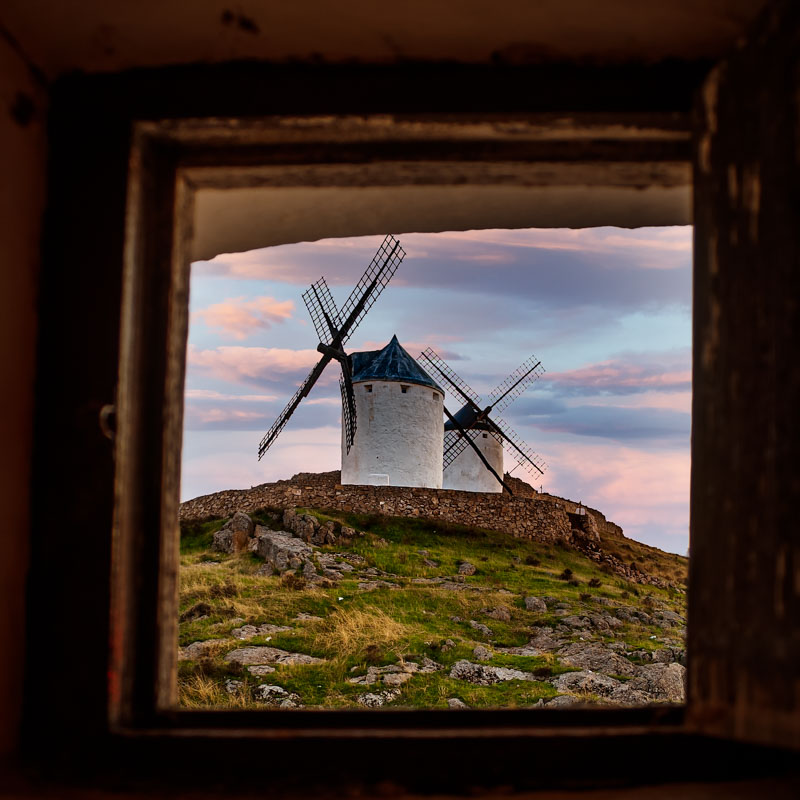
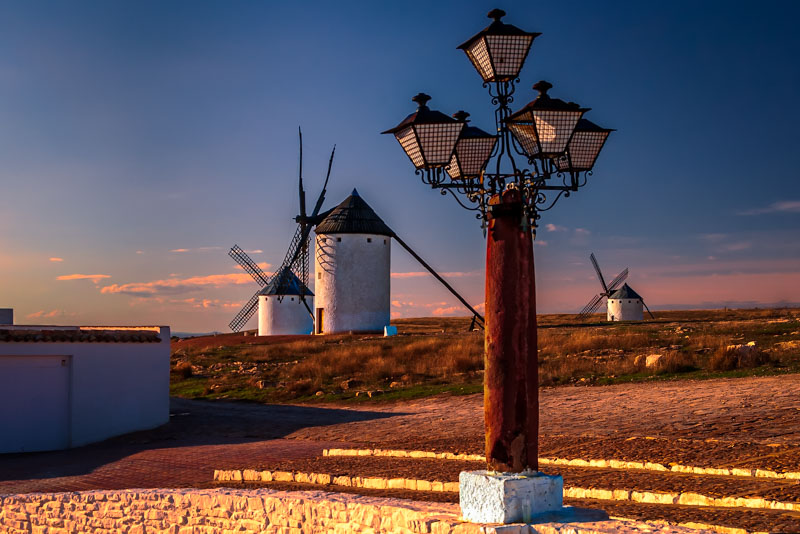
Consuegra has twelve white windmills in a row on the edge of a ridge high above the endless plain of La Mancha. They are the same age as the Cervantes novel, and some of them have been converted into souvenir shops or tourist offices.
Campo de Criptana
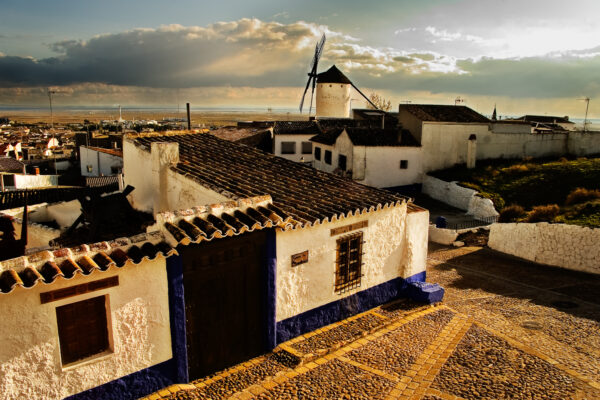
Campo de Criptana has ten windmills, some of them as old as the Cervantes novel. The old town (Barrio Albaicìn) is a fascinating place of old whitewashed single-storey houses and silent streets. You walk through them to get to the top of the hill where the windmills stand.
Which one do you think was the real location for Don Quixote’s foolish adventures?
Did you like this story?
Subscribe to my newsletter for new photographic stories and travel tales delivered straight to your inbox.
I only write when I have something meaningful to share.
Essential cookies enable basic functions and are necessary for the proper function of the website.
Name
Description
Duration
Cookie Preferences
This cookie is used to store the user's cookie consent preferences.
30 days
These cookies are needed for adding comments on this website.
Name
Description
Duration
comment_author
Used to track the user across multiple sessions.
Session
comment_author_email
Used to track the user across multiple sessions.
Session
comment_author_url
Used to track the user across multiple sessions.
Session
Google's current Sign in with Google client library. It renders the Google sign-in button, or the One Tap prompt, so visitors can log in to your site with their Google account. It replaces the older Google Sign-In platform library.
Set on your own domain by the Sign in with Google client library. Records whether the visitor has dismissed the One Tap sign-in prompt and for how long it should stay hidden, plus the time the library last loaded and a browsing session id used for the same purpose. Sites that pass a custom state_cookie_name will see that name instead.
180 days
g_csrf_token
Set on your own domain by the Sign in with Google client library and submitted together with the sign-in credential, so your site can confirm the sign-in came from its own page and not from a forged cross-site request.
5 minutes
Statistics cookies collect information anonymously. This information helps us understand how visitors use our website.
Google Analytics is a powerful tool that tracks and analyzes website traffic for informed marketing decisions.
Contains information related to marketing campaigns of the user. These are shared with Google AdWords / Google Ads when the Google Ads and Google Analytics accounts are linked together.
90 days
__utma
ID used to identify users and sessions
2 years after last activity
__utmt
Used to monitor number of Google Analytics server requests
10 minutes
__utmb
Used to distinguish new sessions and visits. This cookie is set when the GA.js javascript library is loaded and there is no existing __utmb cookie. The cookie is updated every time data is sent to the Google Analytics server.
30 minutes after last activity
__utmc
Used only with old Urchin versions of Google Analytics and not with GA.js. Was used to distinguish between new sessions and visits at the end of a session.
End of session (browser)
__utmz
Contains information about the traffic source or campaign that directed user to the website. The cookie is set when the GA.js javascript is loaded and updated when data is sent to the Google Anaytics server
6 months after last activity
__utmv
Contains custom information set by the web developer via the _setCustomVar method in Google Analytics. This cookie is updated every time new data is sent to the Google Analytics server.
2 years after last activity
__utmx
Used to determine whether a user is included in an A / B or Multivariate test.
18 months
_ga
ID used to identify users
2 years
_gali
Used by Google Analytics to determine which links on a page are being clicked
30 seconds
_ga_
ID used to identify users
2 years
_gid
ID used to identify users for 24 hours after last activity
24 hours
_gat
Used to monitor number of Google Analytics server requests when using Google Tag Manager






great !!!
Reblogged this on International Photography Magazine.
Reblogged this on EarlGrey&Ink and commented:
Photo Of The Day
Thanks a lot